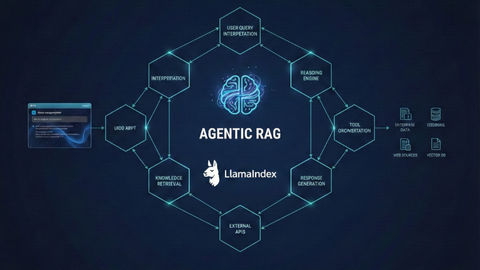

Retrieval-Augmented Generation changed how AI accesses external knowledge, but basic RAG simply fetches relevant information. Agentic RAG transforms this into reasoning-driven processes where systems plan, reflect, and self-correct, achieving significantly higher factual accuracy.
This intermediate training teaches building intelligent agents that don’t just retrieve data but understand when retrieval succeeds, when it fails, and how to improve their approach autonomously. You’ll work hands-on with LlamaIndex across 4 hours of interactive lessons building an AI research assistant.
Understanding Agent Architecture
The course unpacks agent anatomy: memory systems storing context, tool collections enabling actions, and orchestration logic driving self-directed behavior. You’ll understand how these components work together creating systems that reason about their own processes.
Agentic reasoning strategies progress from ReAct patterns through multi-agent systems. These aren’t theoretical frameworks but practical architectures you’ll implement, understanding when each approach suits different problems.
LlamaIndex Implementation
You’ll build a complete AI research assistant demonstrating agentic RAG principles. This involves assembling tools the agent uses, defining retrieval strategies determining how information gets accessed, and designing reasoning loops enabling self-correction when initial approaches fail.
The comparison between basic RAG and agentic RAG clarifies what separates simple retrieval from intelligent, adaptive systems. You’ll see concrete differences in code, architecture, and results.
Evaluation and Optimization
Generic “it works” assessments don’t cut it for production systems. You’ll debug, evaluate, and refine agentic workflows using structured metrics: faithfulness measuring factual accuracy, context recall assessing retrieval completeness, and answer quality evaluating final responses.
These metrics bridge theory and practice, providing objective measures showing whether your agents actually improve or just appear smarter through complexity.
Production Deployment
Prototypes demonstrate concepts. Production systems serve users reliably at scale. The advanced modules cover dependency graphs managing complex agent interactions, deployment guardrails preventing failures, and architectural patterns supporting scalable agentic systems.
You’ll understand challenges moving from local development to production environments where latency, costs, and reliability matter enormously.
Interactive Learning Environment
Educative’s platform eliminates passive video watching. You’re coding immediately in interactive environments, implementing agents, testing retrieval strategies, and debugging issues as they arise. Personalized feedback adapts to your progress.
The curriculum comes from ex-MAANG engineers and PhD computer science educators who’ve built AI systems professionally. They understand what actually matters in production versus what sounds impressive theoretically.
Rated 4.8 stars, this intermediate course assumes familiarity with basic RAG concepts and Python programming. You’re not learning RAG from scratch but advancing to intelligent, reasoning-driven implementations that represent the cutting edge of retrieval systems.