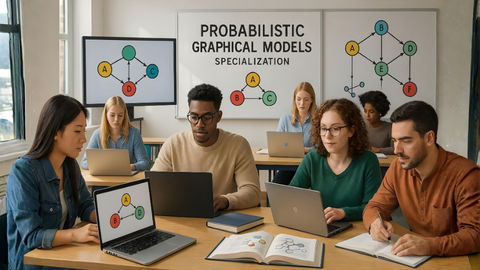

Complex domains with hundreds of interacting variables demand sophisticated reasoning frameworks. Traditional statistical methods struggle when multiple random variables influence each other simultaneously, yet these scenarios define modern AI challenges from medical diagnosis to speech recognition.
This specialisation teaches you to build and deploy probabilistic graphical models (PGMs), a powerful framework sitting at the intersection of statistics and computer science. You’ll master how to encode joint probability distributions over large variable sets, leverage graph algorithms for efficient computation, and apply these techniques to real-world applications.
The curriculum progresses through three focused areas. First, you’ll learn representation methods for structuring complex probabilistic relationships. Next, you’ll tackle inference algorithms that extract meaningful predictions from your models. Finally, you’ll master learning techniques that enable models to improve from data automatically.
Daphne Koller, the Rajeev Motwani Professor at Stanford and recipient of the MacArthur Fellowship, designed this program to bridge theory and practice. Her research in computational biology and machine learning informs every lesson, ensuring you learn techniques actively used in cutting-edge AI research.
What sets this apart is the applied focus. Through programming assignments and projects, you’ll implement Markov models, develop network analysis skills, and apply statistical methods to domains like image understanding and natural language processing. You’re not just studying theory but building the foundation for state-of-the-art machine learning systems.
Whether you’re advancing into AI research or solving complex industry problems, PGMs provide the mathematical toolkit for modeling uncertainty and learning from data at scale.